Beginning July 7, 2025, Pima Trail will be closed to all traffic from the intersection with Aztec and continue east to a point approximately 350 feet to 1607 Pima Trail. The Pima Trail roadway construction project is currently scheduled for completion by September 30, 2025. The developer, JKG 3 Builders, LLC, will be constructing the entire roadway section. These improvements include curb and gutter and a roadway section that is brought up to city standards.
Harker Heights Mayor Michael D. Blomquist is pleased to share significant progress in the City’s efforts to address the financial impact on City services of the State’s property tax exemption for 100% disabled veterans. On May 19, 2025, the Texas Senate passed HB 2894 with a committee substitute that includes reimbursement relief for Harker Heights. The bill now returns to the House, where members must accept and approve the Senate's substitute version — a vital step toward reconciliation and final passage. Once approved, the bill will move to the Governor’s desk for signature into law.
This milestone follows years of advocacy by the City, which has long been disproportionately affected by the exemption program. Since 2010, Harker Heights has lost more than $25.6 million in ad valorem tax revenue, with a $4.39 million loss this fiscal year alone. These exemptions are growing at nearly 17% per year, and in 2024, they removed $827 million in taxable value from the City’s tax roll, accounting for 79.3% of all exemption-related losses.
Despite being the second most impacted city in Texas, Harker Heights has not previously qualified for state reimbursement due to a technicality in the 2015 legislation, which restricts relief to cities located adjacent to military installations. Harker Heights and other communities located just beyond that threshold from Fort Cavazos, have been excluded, despite serving a large population of disabled veterans drawn to its proximity to the base and VA services.
The City emphasizes that veteran exemptions disproportionately impact communities near military installations, where veterans choose to live for access to services and quality of life. City leaders want to be clear: Harker Heights fully supports and honors its veterans and does not oppose the exemptions. However, they urge the State to fully fund any mandates it places on local governments. Without adequate reimbursement, cities like Harker Heights are forced to make difficult budgetary decisions, potentially reducing service levels that impact all residents, including the veterans, these exemptions are meant to support.
The City extends its deepest gratitude to those who have championed this issue over the years. Special thanks go to former City Councilmember Tony Canterino, whose early advocacy helped bring attention to the issue; State Representative Hillary Hickland, whose leadership has been vital in advancing the bill in the House; and Texas Senator Pete Flores, who successfully carried the bill through the Senate. The City also recognizes and appreciates the efforts of many dedicated individuals working behind the scenes to make this long-awaited progress possible.
Inclusion in the reimbursement program represents a critical and overdue step in recognizing the unique financial pressures placed on military-adjacent communities. Harker Heights looks forward to the successful reconciliation and Governor Abbott’s signing of HB 2894 into law and remains committed to delivering high-quality services for all its residents.

The City of Harker Heights is Hiring! Check out our latest video and view the current job listings at https://www.governmentjobs.com/careers/harkerheights.
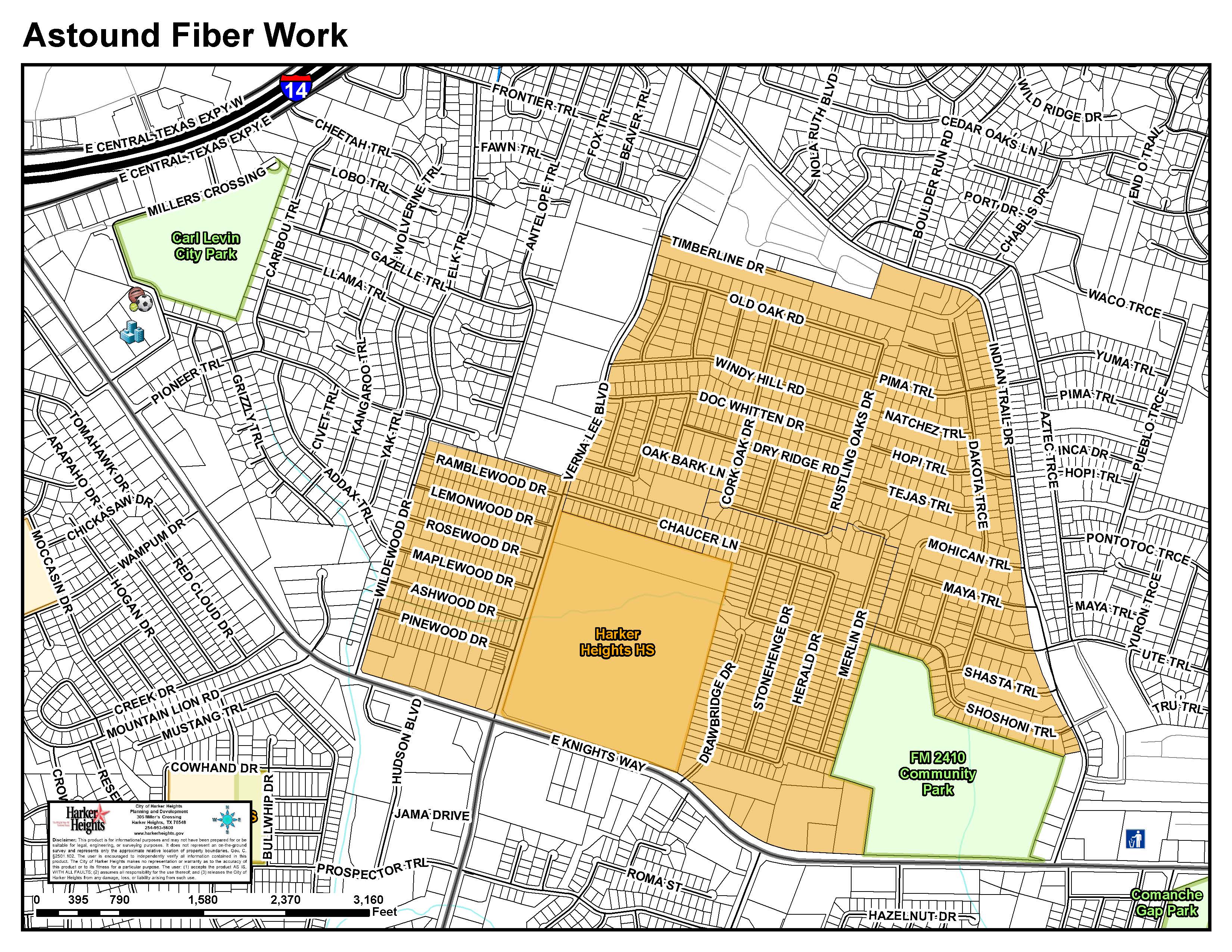
Astound has begun the next phase of their Fiber Installation project. Below is a map for this additional area of construction, with the impacted areas boundary shown in gold. The phases and areas are determined by each individual utility company. The projects are not necessarily constructed in numerical or geographical order. As a reminder, the City is not contracted to install fiber in our community. Each fiber company is an independent utility, similar to Oncor and Atmos. There are currently eight fiber companies permitted to work within the City’s public utility easements and street right of way. The City does not control the timeline nor contractors for these fiber installations. Please know that Astound will have construction projects in different parts of the City through the end of 2026.
Residents in the impacted area will see flags in their yard starting to appear. It is important to leave those public utility flags in place because they show the location and type of existing utilities that are located underground. This is done for the safety of the workers and to minimize disruption of your utility services.
All of Astound’s work will be done in the Public Right-of-Way or within public utility easements. Please note that the existing public utility easements may be in your back yard, side yard or front yard. Some of their work will be above ground and some will be beneath ground. Astound may request to access your backyard utility easement via your gate in order to not have to take down your side yard fence to access the easement. Astound will place door hangers in the neighborhoods where they will be working. Specific questions regarding repair of yards after construction can be directed to Astound’s Construction Supervisor, Billy Bierschwale, at 254-228-0130.

The Environmental Protection Agency has recently released updated guidelines for lead and copper monitoring for public drinking water providers throughout the country. The new guidelines, known as Lead and Copper Rule Revisions (LCRR), require water systems to prepare an inventory of service line materials by October 2024.
The service line is the piping that connects the home or business to the water main. The city and the property owner share ownership of the service line. The city owns the portion from the main to the water meter, including the water meter. The property owner is responsible for the portion from the meter to the point it enters the home or business, as well as all the plumbing in the home or building.
Under the new LCRR requirements, the city must identify service lines, including both the city-owned portion and the customer-owned portion, which might contain lead. Currently, there are no known lead service lines in Harker Heights’ water systems. However, efforts to identify the service line material for each service line connecting to the city’s water systems are ongoing.